Tuesday, November 30, 2010

Putting Relativity to the Test

Albert Einstein lecturing in Vienna in 1921.

In the hundred plus years since Einstein published his theory of relativity it has been put to the test many times. General relativity—Einstein’s theory of gravity—has been tested by measuring the apparent shifting of position of stars whose light passes near the sun during a solar eclipse (known as gravitational lensing, discussed here). It has also been used to explain the wobble in Mercury’s orbit around the Sun.
  Special relativity, the theory that introduced the concept of spacetime, and from which Einstein derived his famous equation E=mc2, has also been tested—most famously by Michelson and Morley (discussed here) who confirmed that the speed of light is constant as Einstein predicted. Another aspect of special relativity—time dilation—has been confirmed by comparing the time on an atomic clock sent on an around-the-world airplane trip with one left behind. There is a very small difference between the time for the two clocks which agrees precisely with Einstein’s theory. 
  Now it looks like relativity may again be tested, this time by physicists working at CERN who have managed to create and trap small quantities of antimatter by using very powerful magnetic fields in devices known as Penning traps. The antimatter they’ve created is antihydrogen. A normal atom of hydrogen consists of a positively-charged proton bound to a negatively-charged electron. Antihydrogen, however, is made by binding a negatively-charged antiproton to a positively-charged electron or positron. According to Einstein’s theory, if scientists can collect enough antihydrogen to do a spectrum analysis, it should match the spectrum for hydrogen exactly. It’s a long shot that the spectrums will differ, but if they do it would leave many physicists in shock, and quite likely earn the team that discovers it a Nobel Prize.

1) True of false: Einstein’s theory of relativity predicts that gravity can bend light.

2) Antihydrogen is created by binding an antiproton with a(n) _________________.
a) positron  b) antineutron  c) proton  d) electron

3) True or false: a clock in motion runs slower than a clock at rest.

4) Antimatter has been contained in small quantities using a _________________.
a) strong electric field  b) weak magnetic field  c) Penning trap  d) graduated cylinder

5) In E=mc2, the constant c stands for _________________.

For additional content, musing and discussions follow us on facebook.

Tuesday, November 23, 2010

An Evolutionary Snapshot

Falcarius skeleton reconstruction, courtesy of 
Utah Museum of Natural History.
Packed into a two-acre excavation site near Green River, Utah are hundreds, maybe thousands, of fossilized remains of a new dinosaur species discovered back in 2001: Falcarius utahensis. 
  This species lived about 125 million years ago during the early Cretaceous Period. Falcarius walked on two legs. Adults measured about four meters from head to tail and were well over a meter tall. They had sharp, curved, claws measuring up to 15 cm in length and were probably covered with hairy feathers. It’s thought that these creatures are one of the ancestors to modern-day birds.
Artistic rendering of a Therizinosaur, courtesy of Nobu Tamura.
  Yet the most interesting aspect of these dinosaurs is that they are thought to have been omnivores. Dr. Scott Sampson, chief curator at the Utah Museum of Natural History and coauthor of a study on Falcarius published in the May 2005 issue of Nature, is quoted as saying that Falcarius “...is the missing link between predatory dinosaurs and the bizarre plant-eating Therizinosaurs.” 
  Evidence that it ate plants includes a large pelvis bone to support a larger intestinal tract that’s needed for digesting plants. Falcarius also had leaf-shaped teeth which were ideal for eating plant material. Yet—like Velociraptor—they had sharp, curved claws for hunting, so it’s thought that they also caught and ate small animals.
  The name Falcarius comes from Latin, and means sickle maker which aptly describes its unusual clawed limbs. The name may not be as catchy as T-Rex or Velociraptor but this dinosaur is definitely interesting.


1) True or false: Falcarius is thought to be an herbivore.

2) Falcarius is believed to have been covered with __________.
a) smooth skin  b) scales  c) fur  d) hairy feathers

3) True or false: Falcarius had teeth that were well-suited for eating plants.

4) Falcarius is thought to be a missing link between carnivores and ____________.
a) Velociraptor  b) lizards  c) herbivores  d) omnivores

5) Falcarius is Latin for _________.

Wednesday, November 17, 2010

Cliff Palace

Cliff Palace at Mesa Verde National Park

Mesa Verde National Park, located near the southwest corner of Colorado, is home to some of the best-preserved ancient cliff dwellings in the world. The largest structure is called Cliff Palace. It was built by the Anasazi people—ancient ancestors of today’s Puebloans—over 750 years ago.
  Recent studies reveal that Cliff Palace had 150 rooms and 23 kivas, or rooms used for religious ceremonies. It’s estimated that about 100 people lived at Cliff Palace. This is quite a departure from the typical cliff dwellings found at Mesa Verde National Park, which contain from one to five rooms each, with many of the single room structures being used for storage. Archaeologists believe that Cliff Palace was used mainly for religious ceremonies.
  Looking at the size of the doorways in Cliff Palace one realizes just how small the Anasazi people must have been—an average man being about 163 cm (5’4”) tall, and an average woman being about 152 cm (5’0”) tall. The Anasazi’s life span was relatively short, partly because of an exceptionally high infant mortality rate. Sadly, about half of their children died before their fifth birthday, with most adults only living into their mid- to late-30s. One can only imagine the hardships they must have faced!
  Cliff Palace is mainly constructed of sandstone, mortar and wooden beams. The Anasazi would collect hard river rocks and use them to shape the larger sandstone blocks for the bulk of their structures. For mortar, they used a mixture of soil, water and ash. They would fill the gaps in the mortar with smaller “chinking” stones to add stability to the walls. Then they painted the surface of the walls with colored plaster made from mud and clay.
  Ansel Adams visited Cliff Palace in 1941 and published several spectacular photographs which can be viewed online at the National Archives website, along with his other photographs of our national parks: www.archives.gov/research/ansel-adams

1) True or false: Puebloans are the ancient ancestors of the Anasazi peoples.

2) Cliff Palace was used mainly for _______________.
a) grain storage  b) living quarters  c) religious ceremonies  d) recreation

3) True or false: The Anasazi people were much smaller than modern people.

4) Rocks used to increase the stability of the walls of Cliff Palace are called ____________.
a) sandstone blocks  b) chinking stones  c) river rocks  d) mortar

5) Cliff Palace was photographed in 1941 by __________.

Tuesday, November 9, 2010

Little Green Men

A composite image of the Crab Nebula showing the
X-ray (blue), and optical (red) images superimposed. 
Within the depths of the Crab Nebula there lies a beast. It is an object that is only 19 km in diameter and emits pulses of radio waves at a rate of 30 times per second. These pulses are so powerful that they light up the entire nebula. This object is the remnant of a supernova explosion, one of the most energetic events in the entire universe. It’s a pulsar—a rotating neutron star. A star so dense that a teaspoon of it would have a mass about 900 times that of the Great Pyramid of Giza. It’s so dense that the atoms within it have collapsed in the gravitational crush to the point where electrons have been pulled into the nucleus converting protons into neutrons. 
  A pulsar creates a magnetic field a million times more powerful than earth’s. It also creates powerful beams of electromagnetic radiation emanating from its two poles. The reason that pulsars pulse is because they are rotating. As they rotate, we detect these jet of radiation at regular intervals, much in the same way that a lighthouse works.
Because a pulsar rotates about an axis that is not
aligned with its magnetic poles, an observer will see
regular pulses of radiation as the magnetic poles
come in and out of sight.
  The Crab Nebula pulsar was formed in the aftermath of the supernova explosion of 1054 AD and was recorded by Chinese and Arab astronomers at the time. For two years it was visible to the naked eye and at its peak it was the second brightest object in the night sky, being surpassed only by the moon. Thanks to these ancient astronomers this was the first recorded instance of a supernova explosion.
  The first pulsar was discovered in 1967 by Jocelyn Bell and Antony Hewish. At first they were perplexed by the regularity of the pulses, and named their find LGM-1 which stands for little green men. Some thought that pulsars might be radio beacons from alien civilizations and it wasn’t until about a year later that astrophysicists were able to determine what was really going on.

Monday, November 1, 2010

Quantum Quotes

Much has been written about quantum mechanics and how difficult—if not impossible—it is to grasp its true meaning. Niels Bohr, the Danish physicist who won a Nobel Prize in 1922 for his contributions to the understanding of quantum mechanics, said “Those who are not shocked when they first come across quantum theory cannot possibly have understood it.” Noted physicist Richard Feynman echoed this sentiment by saying “I think I can safely say that nobody understands quantum mechanics.”
Schrödinger's cat is placed in a sealed box with a flask containing a poison and some radioactive material. If the Geiger counter detects radiation the flask is broken and poison is released killing the cat. Quantum mechanics can be interpreted to say that after a while the cat is both alive and dead.
  Erwin Schrödinger, famous for his thought experiment where a cat could be simultaneously alive and dead depending on the occurrence of a random quantum event, said this regarding quantum theory: “I do not like it, and I am sorry I ever had anything to do with it.” Considering that he won a Nobel prize in 1933 for his famed Schrödinger equation which is central to quantum mechanics, one would hope he was joking! The aspect of quantum mechanics that particularly bothered Schrödinger is called “quantum leaping”, where an electron instantaneously jumps from point A to point C without ever passing through point B.
  Perhaps the biggest critic of quantum theory was Einstein, who jokingly said “Marvelous, what ideas the young people have these days. But I don’t believe a word of it.” Eventually he was convinced that it did indeed have merit, but even then it was his belief that the ability to understand what’s actually happening at the subatomic level exceeds the mental powers of physicists. In a 1926 letter to Max Born, Einstein wrote in reference to quantum theory “I, at any rate, am convinced that God does not throw dice.” In response, Bohr famously said, “Einstein, stop telling God what to do.”


1) True or false: quantum theory is easily understood.

2) ______________ won a Nobel Prize for his quantum theory equation.
a) Albert Einstein  b) Niels Bohr  c) Richard Feynman  d) Irwin
Schrödinger

3) True or false: Einstein was a critic of quantum theory.

4) A mental exercise that would be difficult or impossible to perform is called a(n) _________________.

5) The ability of an electron to instantly jump from one location to another is known as _________________________.


For additional content, musing and discussions follow us on facebook.

Tuesday, October 26, 2010

You've got c-mail?

J.J. Thomson & Ernest Rutherford
How does one go about discovering a particle so small that nobody can see it? The British physicist J.J. Thomson won the Nobel prize in 1906 for doing just that—discovering the electron. At Cambridge University, Thomson was the epitome of an absentminded professor, sporting a tweed jacket, round-rimmed spectacles, mustache and dishevelled hair. 
  While exploring the nature of cathode rays, he discovered that he could deflect their path with an electric field. Measuring the amount of deflection under various strength fields, he was able to determine the mass of these particles, which he found to be about 1,800 times lighter than the hydrogen atom. 
  He called these particles “corpuscles,” and (incorrectly) suggested that they make up all of the matter in atoms. Most scientists at the time believed that the atom was the most fundamental unit of matter and indivisible, so to them this was a shocking concept.
The "plum pudding" model of the atom
  Thompson proposed a “plum pudding” model for the atom, in which thousands of tiny, negatively charged corpuscles move about inside a massless cloud of positive charge. This theory was disproved by a former student of Thomson, Ernest Rutherford. By examining how alpha particles scattered after colliding with a thin sheet of gold foil, Rutherford found that the atom must have a small core, or nucleus. Rutherford proposed that the atom might resemble a tiny solar system, with a massive, positively-charged center orbited by electrons.
Rutherford's gold foil experiment
  Luckily the name corpuscles did not stick or else today we would be going to corpuscular stores like Radio Shack, or reading c-mail instead of e-mail. Eventually the word electron gained favor. It comes from the Greek word for amber, which was known for its ability to electrostatically attract small objects when rubbed with fur.


Monday, October 18, 2010

America's Secret Canyon

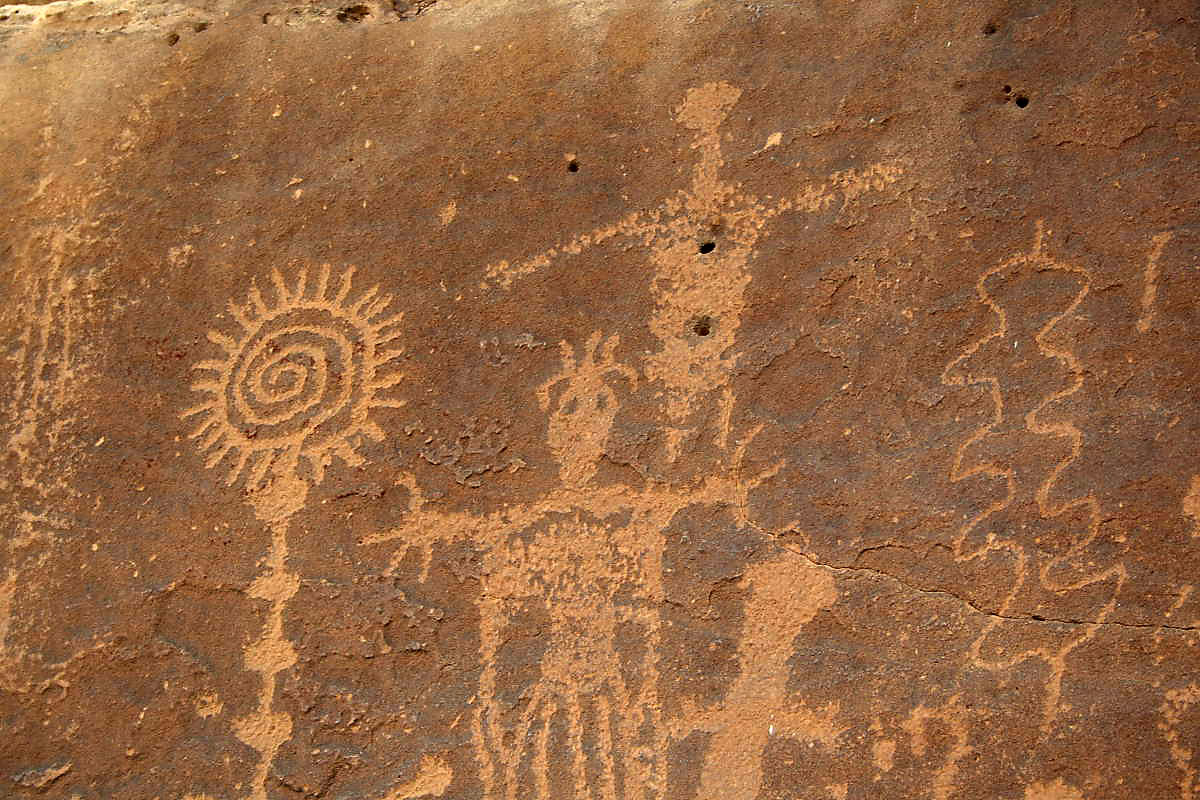
A Fremont petroglyph

Hidden away in a rugged and remote corner of eastern Utah lies one of the most unique archeological sites in North America—Range Creek Canyon. Native Americans known as the Fremonts lived there for several hundred years up until about 1,300 AD when their way of life came to a sudden and mysterious end. Similar to the Anasazi, the Fremonts were ancestors of today’s Pueblo peoples.
  The site remains largely untouched today thanks to Waldo Wilcox. He is the rancher that owned the land and protected this secret for 50 years until he eventually sold it to the state of Utah in 2001. Currently, the land is under the care of the University of Utah’s Archeology Department.
A stone and adobe granary
  The Fremonts hunted and farmed. They grew corn and stored it in stone and adobe granaries that they built in out-of-the-way cliff sides. Over 38 have been identified so far. These granaries are at many different elevations and often located in extremely precarious spots. It is thought that in lean years they stored their corn in higher, more difficult to reach areas in order to protect their limited food supply. 
A Fremont petroglyph
  They were also prolific artists, creating many carvings into the cliff walls (know as petroglyphs) and paintings in caves and on rocks (known as pictograms). Their cave dwellings were well crafted and a rich source of artifacts: pottery, stone tools, arrowheads and other items. This unique find will no doubt be carefully studied for years to come and promises to reveal many details of their lives.

1) True of false: Ranch Creek Canyon was home to the Fremont people a thousand years ago.

2) The Fremonts relied on the farming of ______________ which they stored in stone and adobe ______________________
a) corn, baskets  b) wheat, caves  c) corn, granaries  d) wheat, granaries

3) True or false: Petroglyphs are paintings on rock or cave walls.

4) Range Creek Canyon is being studied by _________________.
a) the state of Utah  b) the Utah University Geology Department  c) Waldo Wilcox  d) the Utah University Archeology Department.

5) The Fremonts are similar to what other ancient tribe?